
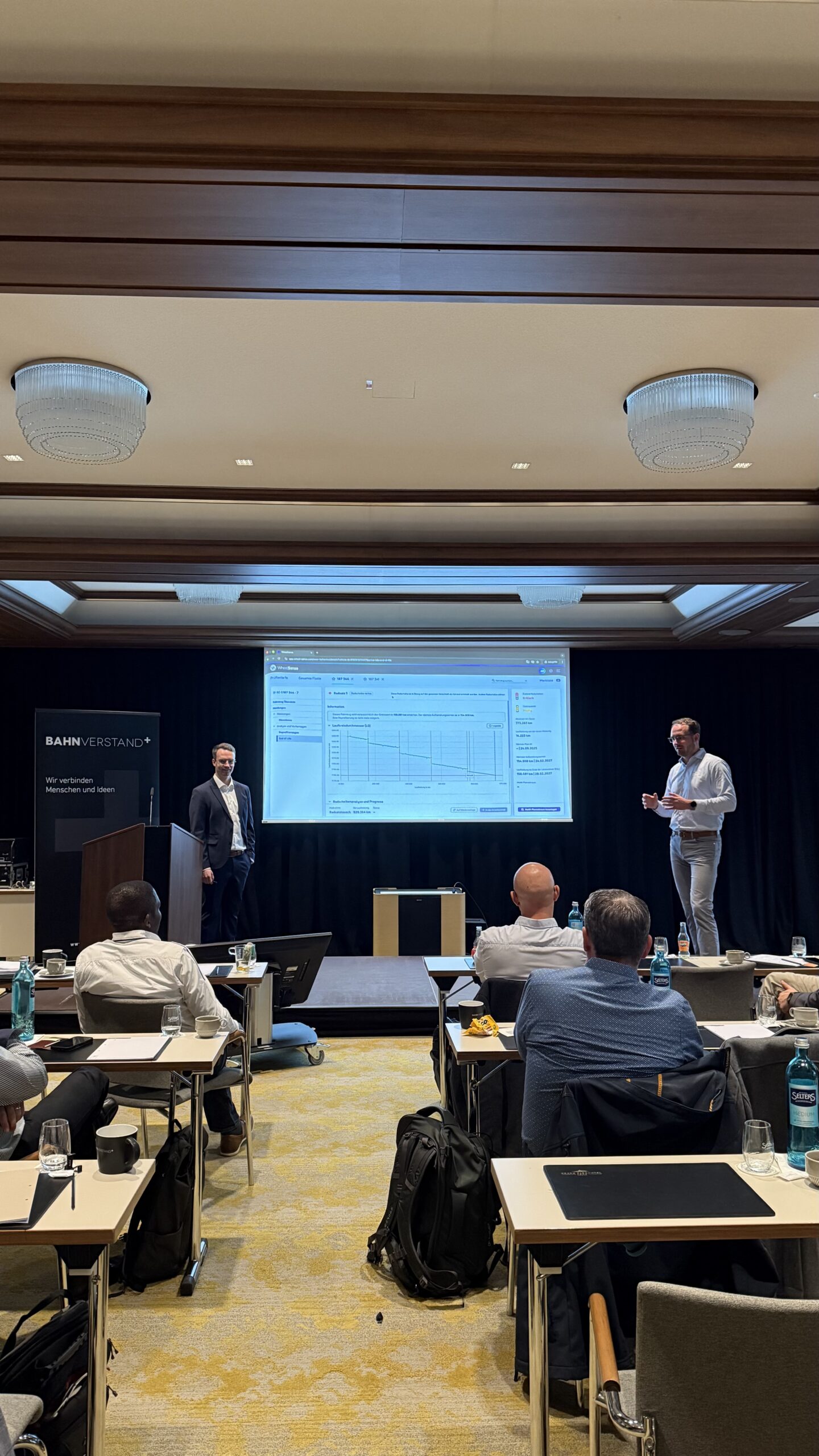
Siegburg Specialist Conference on Railway Vehicle Maintenance 2025
Intelligent wheelset management in action: Our presentation with RAILPOOL in Siegburg
How can large amounts of measurement data be turned into better decisions? This was the key question at the heart of our joint presentation with Christoph Schneider from RAILPOOL at the Railway Vehicle Maintenance Conference 2025 in Siegburg.
Under the title “Intelligent wheelset management … in action?” we showed why the rail industry already collects large amounts of data, but often does not yet use it consistently enough. Measurement data alone does not create transparency. Only when it is consolidated, analyzed, and translated into concrete recommendations can real efficiency gains and cost-saving potential be achieved.
Data is generated in many places – but it rarely comes together.
RAILPOOL is one of Europe’s leading locomotive leasing companies. With more than 500 locomotives in operation across 19 European countries and collaboration with over 40 maintenance sites, data is generated every day in many different places: in operations, in workshops, along the infrastructure, and within existing IT systems.
The central challenge: this data often does not come together.
This is precisely what leads to an incomplete picture in practice. The actual condition of the wheelsets is often only known at specific points in time. Decisions on maintenance, reprofiling, or refurbishment have to be made even though important information is missing or not consistently available.
Why traditional maintenance reaches its limits
Maintenance intervals today are often based on experience, historical data, and additional safety buffers. This is understandable, but it leads to inefficiencies: some wheelsets do not reach the planned interval, while others could have remained in service for significantly longer.
In practice, this means rigid inspection intervals, manual documentation, data silos, and a lack of end-to-end data continuity between workshops, operators, and ECMs. The result: avoidable vehicle downtime, long workshop waiting times, uncontrolled material loss, and unnecessary administrative effort.
For modern fleet management, it is therefore no longer enough to simply record measurement values. The key is to make them usable.
Turning measurements into decisions
In our presentation, we therefore described the approach WheelSense takes:
Sensor → Analysis → Trend → Recommendation → Decision
Intelligence emerges where measurement data is translated into decision logic. This is exactly where WheelSense comes in: existing wheelset data is analyzed, wear trends are made transparent, and concrete recommendations for action are derived.
This makes it possible to identify refurbishment needs at an early stage, plan workshop appointments more precisely, and manage vehicle life cycles with greater transparency. WheelSense analyzes trends in measurement values, monitors relevant parameters such as flange thickness and flange height, and helps ensure that reprofiling needs are not only identified during the next workshop visit.
Predictive decisions instead of reactive measures
A particularly important point in our presentation was the question of how premature or unnecessary refurbishment can be avoided. If the wear of a wheelset cannot be predicted accurately, high costs and longer downtimes can quickly arise.
WheelSense enables the prediction of diameter development while taking the entire wheel profile and future reprofiling into account. This allows decisions to be made more proactively and maintenance measures to be planned more effectively.
Dynamic maintenance limit values also play an important role in this context. Instead of viewing limits solely as vehicle-specific and uniform thresholds, they can be aligned more closely with individual wear behavior. This creates additional flexibility, for example at the end of a wheel disc’s service life, for profile specifications based on individual wear, or when changing wheelset rotations.
Our conclusion from Siegburg
The exchange at the conference showed that the industry is ready for the next step in wheelset management. In many places, the data is already available. The task now is to connect it more effectively, prepare it in a clear and understandable way, and translate it into reliable decisions.
Or as we put it in our presentation: in the end, it is not about winning a sprint, but about mastering the long distance efficiently and safely. Those who understand their running behavior stay in the race longer.
Our goal with WheelSense is clear: we want to help fleets operate reliably, efficiently, and proactively.

